The Power of Beliefs


In 2004 the agency Crispin Porter + Bogusky sought to help Burger King advertise their tendercrisp chicken sandwich “served your way.” They built a campaign called The Subservient Chicken and created a sparse website with a video feed of a person in a shabby, maniacal chicken costume standing at attention in a small apartment living room. There were a couple chairs and a couch, a TV and a bookshelf. Not much else. Visitors were given a textbox and invited to command the chicken to do things—and when they did, the chicken obeyed. He did the splits. Lunges. He hid behind the couch. Read a book from the bookcase. It felt to every user like they were connected, Chat-Roulette style, to their own personal chicken who would do whatever they wanted.
In reality, the actions were pre-recorded, with the chicken always resetting to his original stance afterward so that video loops could be stitched together to look live. It turns out that when you put a six-foot chicken in a living room, there is a finite number of things people think to do with it. The agency recorded and keyworded roughly 200 actions, including a shrug for prompts they didn’t anticipate. But most users simply didn’t think of things the team hadn’t already prepared. The illusion worked so well that the site received more than 450 million incredulous visits.
The Subservient Chicken is an illustration of how the total universe of common user behaviors, though bigger than we can hold in our head at one time, is a lot smaller than we imagine. There are outliers, of course, but most businesses serve the 80% of customers who behave predictably far more than the 20% who don’t.
This insight holds true in marketing. When my colleagues and I debated whether our phones must be listening to us to deliver unnervingly accurate ads, I remembered the chicken. Some apps do listen, but it’s vastly cheaper—and more accurate—to identify behavioral segments and serve ads that feel uncanny, but are just playing the odds. For most categories of consumer behavior, people really aren’t that different from each other.
Why This Matters for Ideas
This notion clashes with a culture that prizes individuality, infinite choice, and the mythology of the heroic, world-changing Idea. The Subservient Chicken suggests something different. Ideas matter—but not always in the revolutionary way we like to imagine. Often they are fewer, simpler, and more repetitive than we think.
Companies with “entrepreneurial cultures” often tell their people that ideas can come from anywhere. And they can. But in practice, the same handful of ideas surface everywhere in an organization. People at all levels naturally gravitate to the same obvious opportunities—because obvious ideas occur to us without having to invest time in nuance and mastery.
The point isn’t that ideas lack value. It’s that ideas are not the primary unit of organizational power. What truly mobilizes people, what creates alignment and consistently excellent execution, is belief.
Ideas vs. Beliefs
Ideas
…are propositional: “We should try X.”
…require sell-in, debate, and decision-making.
…tend to scale linearly—slowly—because adoption is optional.
…are fragile: they can be replaced, ranked, or deprioritized the moment a new one appears.
Beliefs
…are behavioral: “This is how we do things here.”
…drive action automatically, often without discussion.
…scale exponentially once shared; they become an operating system.
…are durable: they persist across projects, staff turnover, and leadership changes.
Ideas create options. Beliefs create momentum.
This isn’t semantics. Ideas shape possibilities; beliefs shape behavior. And behavior is what produces outcomes.
Belief Architecture: A Modern Example
Beliefs don’t require lofty mission statements. They simply need to be statements that people experience as reliably true.
To see an organization designed around beliefs rather than novel ideas, look at Papa Murphy’s.
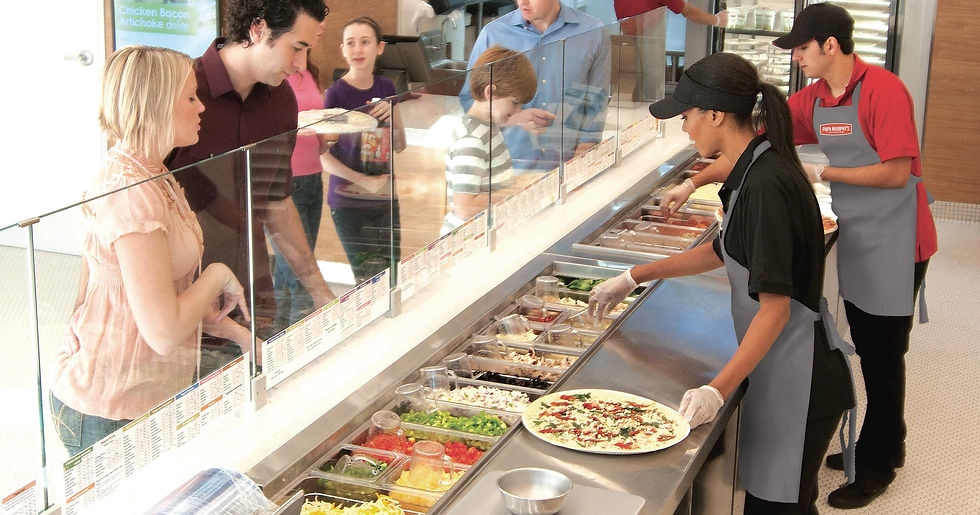
At a conceptual level, the idea behind the chain—take-and-bake pizza—is simple and a little fragile. It only works if customers believe two things:
I can finish this at home without messing it up.
The pizza will taste restaurant-quality even though I baked it myself.
Papa Murphy’s does not leave these beliefs to chance.
Nearly everything they sell bakes at 425°F for 12–18 minutes.This eliminates the fear of doing it wrong. It reinforces belief #1: “You’re not going to ruin this.”
Their stores have no ovens. A capital expenditure savings becomes a brand pillar. The kitchen moves into the open, where an assembly line of teenagers (maybe like the ones you’re bringing pizza home to) builds your pizza from bins of fresh, raw ingredients—visibly fresh, visibly simple, visibly doable. This reinforces belief #2: “This really will turn out great.”
The idea is straightforward. The beliefs are engineered. And those beliefs—shared by both customers and employees—constitute Papa Murphy’s true competitive advantage. Any operational change that undermines these beliefs (complicated baking instructions, ingredients that can’t be handled in the assembly line, etc.) could introduce structural weaknesses to their belief architecture.
A Process for Building Around Beliefs
If belief is the real engine of organizational power, the question becomes: how do you identify and shape the beliefs that matter?
Here is a practical four-step approach:
Identify the beliefs people already hold (for better or worse).
What do employees assume is rewarded or punished?
What do customers assume is true about your brand?These are not your stated values. They are the implicit expectations that shape behavior today.
Define the few beliefs you want people to hold.
Focus on two or three.
Beliefs dilute quickly, so precision is essential.
Locate the friction between existing and desired beliefs.
Where do current practices contradict the culture and brand you want?
Where are you unintentionally undermining the things you want to be believed?
Design reinforcing behaviors and systems.
Beliefs are created through repetition and consistency, not announcements. Build rituals, decisions, investments, and customer experiences that reinforce the desired belief daily.
The Belief Behind the Chicken
The Subservient Chicken succeeded not just because the idea was clever, but because the team believed it would work. They believed—correctly—that the range of human imagination was narrower than people think. They believed that ~200 filmed actions could convincingly simulate infinite possibility. And they believed the illusion would hold.
If they had been wrong—if most prompts had produced the shrugging shoulders—the execution would’ve fallen flat and been forgotten. The idea alone wasn’t enough. It was the conviction behind it that pushed the team to anticipate every likely command, build the indexing system, perfect the reset stance, and make the illusion seamless.
Belief is what turned a clever idea into a cultural moment.
Belief turns average ideas into real outcomes. Belief elevates execution.
Belief aligns people in ways that ideas alone cannot.
Your organization will generate plenty of ideas—usually the same ones found everywhere else. But the beliefs you cultivate, reinforce, and operationalize? If they are deliberate, they are defensible. And those are the true engines of your culture, your brand, and your results.

Comments